My father was a refugee from the Spanish Civil War.
My mother, an American who was born in territories that were once part of México.
The greatest figure in my family was an oceanographer that brought Einstein to Spain in the early years of the Twentieth Century, whose books on natural sciences were forbidden by the Catholic Church, who lost one of his sons – a world-class researcher who fought malaria – by a firing squad, and had to find exile first in France and later in México, where he died.
From my father I got the interest in technology, complex systems and the notion that everything changes very fast.
From my mother, a strong sense of care for all living things and resources.
I proudly recall that fifty years ago my father worked to ensure access to affordable, reliable, sustainable and modern energy for all: he organized several thousand electrical workers to bring reliable electricity to a community of a million people, mainly migrants from rural areas in the outskirts of Mexico City.
That was an accomplishment that is hard to replicate.
I have tried some of my own, though, and there is one I´m particularly very proud of: for México to have in place more than thirty, state-of-the-art energy efficiency standards and a robust system for their compliance, particularly for the equipment that provides energy services in every home.
This has had an impact that is evident at a macro level.
- Average electricity consumption per household is the same as 25 years ago, even as energy services have increased with more and larger equipment.
- Gas use of Mexico´s residential sector has not grown in 20 years after growing at a rate of 6% per year for many years.
- Altogether, more than 70 million large electrical and gas residential appliances have been bought subject to energy efficiency standards and the economic impact, first of all the families of México but also to the public treasury, amounts to about 40 billion US dollars in 20 years.
In retrospect, I have four points of advice:
- For all projects and programs, get support from the top, but design and assemble from the buttom up.
- Energy efficiency standards are a key element of any national strategy. Without technical regulations and a reliable system of compliance it is impossible to assure savings and very expensive to guarantee loans.
- Agencies are key. At a national level, regulations alone are not enough: there has to be a group of paid enthusiasts going around convincing people that their problems can be reduced with energy efficiency.
- It’s all about alliances. Energy efficiency may be as simple as a more efficient lightbulb or better housekeeping, but to have the impact we need requires many heads and hearts going in the same direction: it takes a village.
In a few words: energy efficiency offers us one of the most simple and inexpensive opportunities to make faster progress on SDG7. Yet it requires a technical approach and leadership: stronger regulations, specific institutions, lots of data, communication and many new partnerships to reap its benefits.
I thank Judy, my wife, and our children, Benjamin and Rebeca, for their love and wisdom.
I also thank all of those that have worked with me and made many things possible.
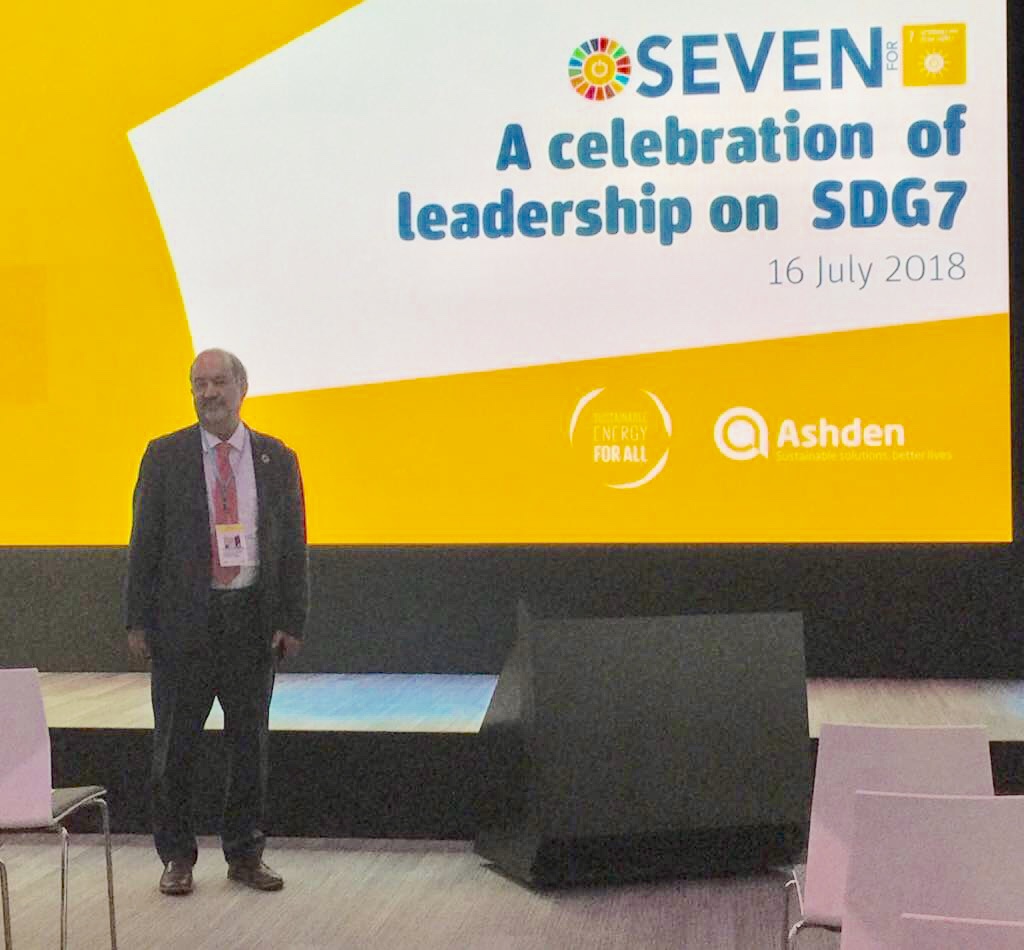
Finally, I thank the great Rachel Kyte, Sustainable Energy for All, the United Nations and the Ashden Foundation for this recognition.
¡Si se puede!.
 Artículos y reportes de Odón de Buen R.
Leave a comment